Advisor Rankings Are Under Scrutiny: What RIAs Need to Know Before Promoting Awards
Featured In: InvestmentNews
, Head of Compliance at STP Investment Services, was featured in a recent InvestmentNews article examining advisor recruiting, industry rankings, and the continued expansion of large registered investment advisory firms.
The article focused on MAI Capital Management’s appointment of Matt Barthel as managing partner of strategic advisor recruiting. Barthel previously oversaw financial advisor rankings and wealth management coverage at Barron’s.
While the appointment reflects the growing competition for advisor talent, it also raises a broader compliance question for RIAs: How should firms use third-party ratings, rankings, and awards in their marketing?
Read the original article on InvestmentNews.
The Bigger Picture
Competition for experienced financial advisors continues to grow, particularly as independent RIAs and private equity-backed platforms expand through recruiting and acquisitions.
Rankings and industry awards can play an important role in that environment. They may help firms strengthen their brands, build credibility with prospective clients, and attract advisors who want to join a recognized organization.
However, the process behind a ranking is not always apparent to the public.
Some rankings may involve participation fees, data-submission requirements, licensing arrangements, event attendance, or payments associated with promoting the final recognition. These relationships do not automatically make a ranking misleading, but they may create disclosure obligations when an adviser uses the ranking in an advertisement.
The compliance issue is not simply whether a firm received an award. The question is whether the way the firm presents that recognition gives clients and prospects a complete and accurate understanding of how it was obtained.
Why Third-Party Rankings Require Careful Review
The SEC’s Marketing Rule addresses advertisements that include third-party ratings. Firms using these ratings must consider whether the presentation is fair, balanced, and supported by appropriate disclosures.
That review should extend beyond the language of the original award announcement.
Before using a ranking on a website, social media post, pitchbook, email campaign, advertisement, or advisor biography, firms should understand:
- Who created the ranking
- What methodology was used
- Whether the adviser paid to participate
- Whether payment was required to promote the results
- What time period the ranking covers
- Which population or peer group was considered
- Whether the ranking applies to the firm, an individual, or a specific team
- Whether the accompanying disclosures are clear and prominent
A hyperlink to a separate disclosure page may not be enough if the material information is not presented clearly alongside the ranking or award.
Clear and Prominent Disclosure Matters
As explained in InvestmentNews:
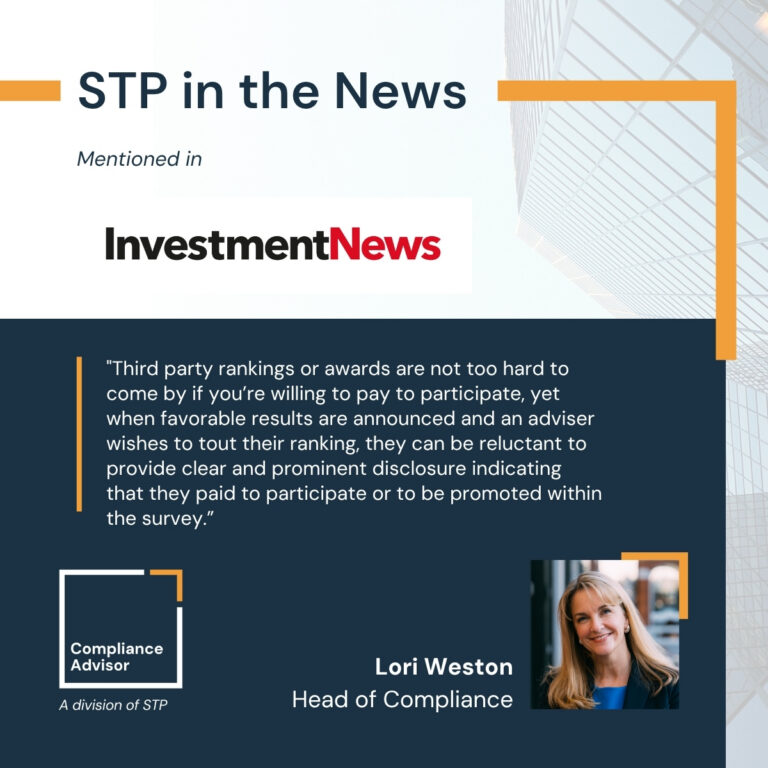
“Third-party rankings or awards are not too hard to come by if you’re willing to pay to participate, yet when favorable results are announced and an adviser wishes to tout their ranking, they can be reluctant to provide clear and prominent disclosure indicating that they paid to participate or to be promoted within the survey. Omitting this disclosure is clearly misleading.”
The central issue is transparency.
A client or prospect should not have to search through a website or follow multiple links to determine whether an adviser paid to participate in a ranking program or promote the results.
Material disclosures should appear close enough to the ranking that the audience can understand the context at the time the claim is presented.
Rankings Can Create Risk Across Multiple Marketing Channels
Once a firm receives recognition, the ranking often appears in more places than the original announcement.
It may be added to:
- The firm’s website
- Individual advisor biographies
- Social media posts
- Email signatures
- Marketing presentations
- Sales materials
- Proposal documents
- Recruiting materials
- Press releases
- Digital advertisements
That expansion creates an opportunity for required disclosures to become separated from the original claim.
For example, a press release may contain appropriate context, while a social media graphic displays only the ranking badge. An advisor biography may continue referencing an award after the relevant ranking period has ended. A recruiting presentation may describe a firm as “top-ranked” without explaining the ranking’s scope or methodology.
Compliance review should therefore address every use of the recognition, not just the first publication.
Advisor Recruiting Adds Another Layer of Complexity
Rankings can also affect how firms position themselves to prospective advisor teams.
As RIAs compete for talent, recognition may be used to demonstrate scale, growth, reputation, or market credibility. That makes rankings relevant not only to client-facing marketing but also to recruiting communications.
Firms should be careful not to overstate what an award demonstrates. A ranking based on assets under management, for example, may not support broader claims about performance, client satisfaction, service quality, culture, or advisor success.
Recruiting materials should present third-party recognition with the same level of accuracy and context expected in other firm communications.
Five Questions to Ask Before Promoting a Ranking
Before publishing an award or ranking, compliance and marketing teams should ask:
1. Did the firm pay anything connected to the ranking?
Determine whether the firm paid to participate, submit data, attend an associated event, license a badge, purchase promotional rights, or advertise alongside the recognition.
2. Are the disclosures placed alongside the claim?
Material information should be easy to locate and understand. Avoid relying exclusively on a distant webpage or general disclosure library.
3. Does the ranking methodology support the marketing language?
The firm should describe the recognition accurately and avoid turning a narrow ranking into a broader claim about the organization.
4. Is the recognition still current?
Marketing teams should track the applicable date, award period, and expiration of any licensing or promotional rights.
5. Has every format been reviewed?
A disclosure that works in a press release may not work on a social media graphic, website banner, presentation slide, or advisor biography.
Marketing and Compliance Must Work Together
Awards and rankings often move quickly through the marketing process. A firm receives notification, creates a graphic, drafts a social media post, updates the website, and distributes the news internally.
That speed can create compliance risk if the ranking is promoted before someone reviews the methodology, participation terms, licensing requirements, and required disclosures.
A coordinated process can help firms manage that risk. Marketing should provide compliance with the original ranking materials, methodology, payment information, proposed language, planned distribution channels, and design assets before publication.
Compliance can then assess whether the recognition is described accurately and whether the disclosures remain clear across each format.
The goal is not to prevent firms from celebrating legitimate recognition. It is to make sure the promotion provides the context clients and prospects need to evaluate it properly.
Key Takeaways for Investment Advisers
- Third-party rankings can create disclosure obligations under the SEC’s Marketing Rule.
- Firms should disclose payments connected to participation or promotion when that information is material.
- Disclosures should be clear, prominent, and presented alongside the ranking.
- Linking to a separate disclosure page may not provide sufficient context.
- Marketing teams should not expand a narrow ranking into an unsupported claim about the firm or advisor.
- Websites, social media, advisor biographies, presentations, and recruiting materials should be reviewed separately.
- Compliance and marketing teams should establish a repeatable approval process for rankings and awards.
- Firms should periodically review previously published recognition to ensure it remains accurate and current.
Frequently Asked Questions
Can an investment adviser promote a third-party ranking?
Yes. However, the adviser must evaluate the ranking and its presentation under the SEC’s Marketing Rule and other applicable requirements. The advertisement should not be misleading and should provide appropriate context about the ranking.
Does a firm have to disclose that it paid to participate?
If payment or compensation is connected to participation in or promotion of the ranking, that information may be material to the audience’s understanding of the recognition. Firms should carefully assess how the payment is disclosed.
Is a hyperlink to the disclosure sufficient?
A hyperlink alone may not satisfy the expectation that material disclosures be clear and prominent. Firms should consider whether the audience can understand the relevant information without leaving the advertisement.
Can the same disclosure be used across every marketing channel?
Not necessarily. The placement and presentation may need to be adjusted for a website, social media post, graphic, advisor biography, presentation, or other format.
Should older awards remain on a firm’s website?
Firms should periodically review older awards to confirm that the ranking date, methodology, scope, and related disclosures remain clear. An older ranking should not be presented in a way that implies it is current.
Do these considerations also apply to advisor recruiting materials?
Recruiting communications should also describe rankings accurately and avoid unsupported claims. Firms should be especially cautious when using recognition to suggest broader conclusions about culture, advisor success, performance, or client experience.
About Lori Weston
is Head of Compliance at STP Investment Services. She works with investment advisers to strengthen compliance programs, address evolving regulatory expectations, and translate complex obligations into practical business processes.
Through STP’s ComplianceAdvisor practice, Lori and the compliance team help firms manage regulatory responsibilities through ongoing compliance support, risk assessments, testing, policy development, regulatory filings, examination preparation, and outsourced Chief Compliance Officer services.