When Internal Operations Stop Scaling for Fund Managers
Featured In: Uncorrelated Magazine
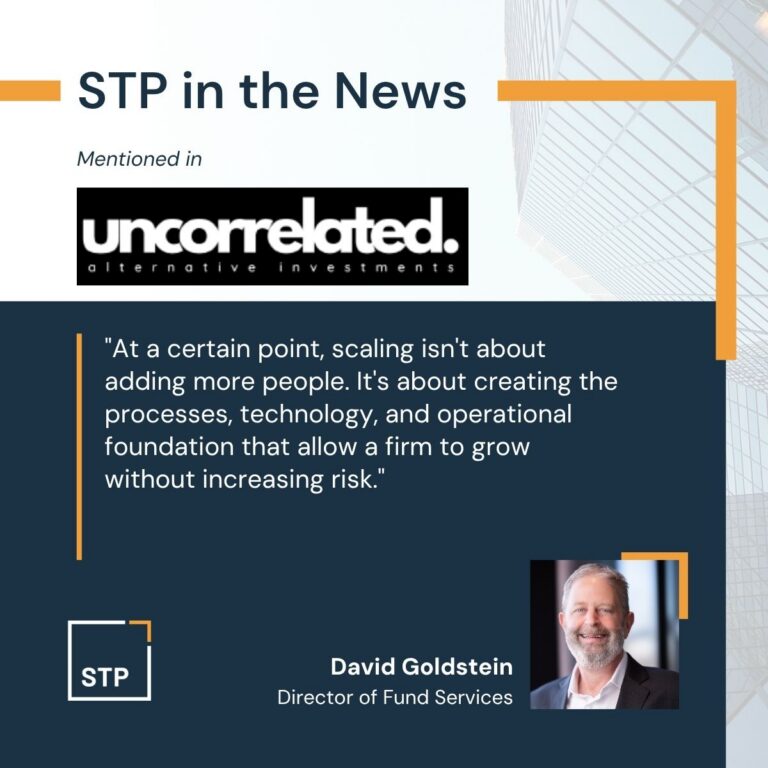
Uncorrelated Magazine recently featured an article by David Goldstein, Director, Product – Fund Services at STP Investment Services, examining one of the most common growth challenges investment managers face: scaling operational infrastructure. As funds grow, investor expectations increase, fund structures become more complex, and operational demands can quickly outpace internal resources.
The Bigger Picture
Many investment managers launch their first fund with a manageable number of investors, investments, and operational workflows. However, growth rarely happens in a straight line. As firms launch additional funds, introduce co-investment vehicles, form special purpose vehicles (SPVs), add new strategies, or expand investor bases, operational complexity can increase dramatically.
Growing demands around accounting, bookkeeping, and investor reporting, while open-ended fund managers must navigate increased trading activity, more complex reconciliations, additional prime broker and custodian relationships, and expanding fund structures. What once felt manageable can quickly become difficult to support with internal resources alone.
As firms scale, operational excellence becomes a strategic advantage rather than simply a back-office function.
Key Takeaways
- Operational complexity often increases faster than internal team capacity as funds grow.
- New fund structures, co-investments, and SPVs create additional accounting and reporting obligations.
- Open-ended funds face increasing reconciliation, trading, and operational demands as assets grow.
- Scalability requires more than additional headcount. It requires technology, redundancy, and strong processes.
- Investors increasingly expect transparency, operational efficiency, and institutional-quality reporting.
- Third-party administrators can help firms scale while reducing operational risk.
David Goldstein’s Perspective
According to David Goldstein, operational scale is not simply a staffing challenge.
“Operational scale isn’t just about hiring more people. True scalability requires built-in redundancy and coverage for key roles, modern and reliable technology that grows with the firm, and accurate, timely, and consistent information flow to investors.”
As managers grow assets and expand their investor base, operational infrastructure must evolve alongside the business. Without the right foundation, firms can face increased operational risk, reporting delays, and challenges meeting investor expectations.
What This Means for Investment Managers
Growth is often viewed as a sign of success, but it can expose operational weaknesses that may have gone unnoticed during a fund’s early years.
Today’s investors expect timely reporting, transparency, strong controls, and institutional-quality operations. At the same time, managers are navigating greater complexity through additional fund structures, larger portfolios, increased transaction volumes, and evolving regulatory expectations.
Building an internal operation capable of supporting this growth requires ongoing investment in technology, talent, and process design. For many firms, partnering with experienced operational providers offers a scalable alternative that allows investment teams to remain focused on portfolio management while ensuring operational infrastructure keeps pace with business growth.
The question for many managers is no longer whether operational scale is important. The question is whether to build that capability internally or leverage specialists who already have the infrastructure in place.
Action Steps for Fund Managers
- Evaluate whether current operational processes can support future growth objectives.
- Review fund accounting, reporting, and reconciliation workflows for scalability.
- Assess technology platforms and integration capabilities.
- Strengthen operational redundancy and business continuity planning.
- Consider whether outsourced fund administration or operational support could improve efficiency and reduce risk.
Frequently Asked Questions
Why do operational challenges increase as funds grow?
Growth often brings additional investors, fund structures, reporting obligations, and transaction activity, all of which increase operational complexity.
What are common signs that operations are no longer scaling effectively?
Reporting delays, resource constraints, reconciliation backlogs, and increased operational risk can indicate scalability challenges.
Why are investors focused on operational infrastructure?
Institutional investors expect transparency, accuracy, strong controls, and consistent reporting as part of their due diligence process.
How can third-party administrators support growth?
Administrators provide specialized expertise, scalable technology, operational coverage, and dedicated resources that help firms manage increasing complexity.
Is outsourcing operations only for large firms?
No. Managers at various stages of growth may benefit from outsourced operational support depending on complexity and internal resource availability.
Why It Matters
Operational infrastructure can become one of the most important factors in a firm’s ability to scale successfully. As investor expectations rise and fund structures become more sophisticated, managers need operational frameworks capable of supporting growth without increasing risk. Firms that proactively address scalability challenges today will be better positioned to support long-term growth, deliver exceptional client service, and maintain investor confidence tomorrow.