Why Standardization Is the Next Frontier for Alternative Investments
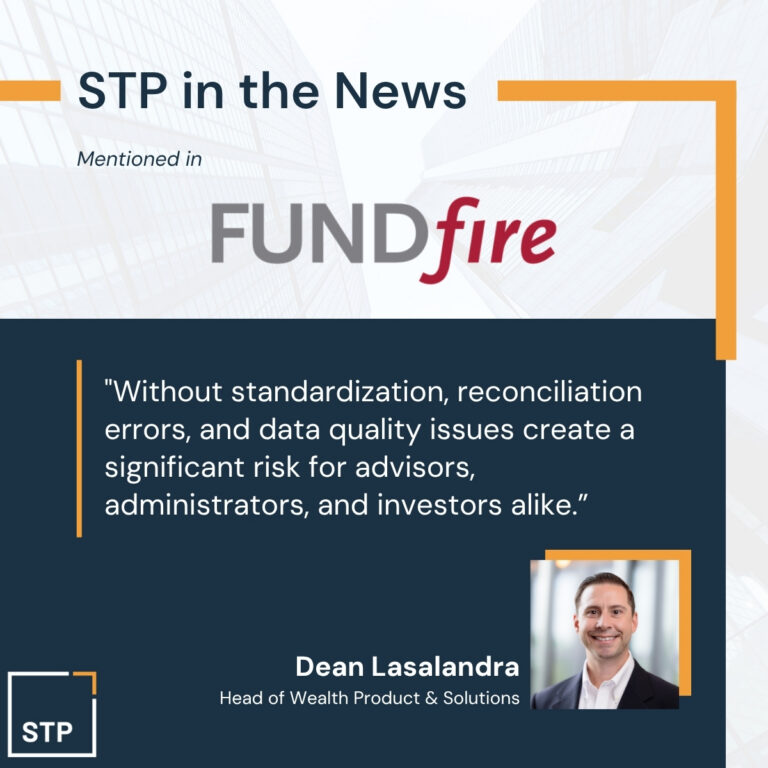
Featured In: FundFire
Dean Lasalandra, Head of Wealth Product & Solutions at STP Investment Services, was featured in a recent FundFire article examining the strategic partnership between iCapital and DTCC. The collaboration aims to streamline private market workflows, reduce operational complexity, and help create a more efficient infrastructure for alternative investments as demand continues to grow among wealth managers and investors.
Read the original article on FundFire.
The Bigger Picture
Private markets have experienced significant growth in recent years, driven by increasing investor demand for alternative investments and expanded access through wealth management platforms. However, much of the operational infrastructure supporting private market investments has struggled to keep pace with that growth.
Today, many private market workflows still rely on spreadsheets, PDFs, manual data entry, email communications, and fragmented reporting processes. Subscriptions, capital calls, distributions, transfers, and net asset value updates often require coordination among fund managers, administrators, advisors, custodians, and technology providers.
As participation continues to expand, these manual processes can create inefficiencies, delays, reconciliation challenges, and operational risk.
The iCapital and DTCC partnership reflects a broader industry effort to modernize the infrastructure supporting private market investments and create greater standardization across participants.
Key Takeaways
- Private market growth continues to outpace existing operational infrastructure.
- Manual processes remain common across alternative investment workflows.
- Standardization can help improve efficiency, scalability, and data quality.
- Advisors are seeking easier ways to incorporate alternatives into client portfolios.
- Automation may reduce reconciliation challenges and operational errors.
- Industry-wide infrastructure improvements could accelerate adoption of alternative investments.
Dean Lasalandra’s Perspective
As highlighted in the article, one of the industry’s biggest challenges is the lack of standardized infrastructure supporting private market investing.
“Private market growth has been outpacing the infrastructure meant to support it.”
— Dean Lasalandra, Head of Wealth Product & Solutions, STP Investment Services
Lasalandra also noted that subscriptions, capital calls, distributions, and net asset value updates are frequently managed through spreadsheets, PDFs, and point-to-point reconciliations between general partners, fund administrators, and wealth platforms, creating inefficiencies that become increasingly difficult to manage as volume grows.
According to Lasalandra, reducing manual interventions and creating a standardized framework can help minimize operational risk while allowing advisors and asset managers to participate more efficiently in private market opportunities.
What This Means for Asset Managers and Advisors
The continued expansion of private markets into the wealth channel is creating new opportunities for growth, but it is also exposing operational challenges that were less visible when participation was limited to institutional investors.
Advisors increasingly want the same seamless experience they have when purchasing traditional investments. However, alternative investment workflows often involve multiple parties, unique documents, custom processes, and manual reconciliation requirements.
As assets continue flowing into private markets, firms that rely heavily on manual processes may find it more difficult to scale efficiently.
Technology integrations, workflow automation, and data standardization can help reduce friction for advisors, investors, administrators, and fund managers alike. In addition, improved interoperability among platforms may help support broader adoption of alternatives across retail and high-net-worth investor segments.
Organizations that invest in operational efficiency today may be better positioned to capitalize on the continued growth of private market investing in the years ahead.
Action Steps for Industry Leaders
- Evaluate current private market workflows for manual touchpoints and bottlenecks.
- Assess data quality and reconciliation processes across platforms and service providers.
- Explore opportunities to automate capital call, subscription, and reporting processes.
- Prioritize infrastructure investments that support scalability and standardization.
- Strengthen partnerships with technology and operational providers that reduce friction and operational risk.
Frequently Asked Questions
Why is standardization important in private markets?
Standardization helps reduce manual processing, improve efficiency, increase data quality, and support greater scalability across the investment ecosystem.
What operational challenges exist in private markets today?
Many workflows still rely on spreadsheets, PDFs, email-based communications, and fragmented systems, creating inefficiencies and operational risk.
How can automation benefit private market investing?
Automation can improve transaction processing, reporting, reconciliation, data sharing, and investor servicing while reducing errors and delays.
Why are advisors increasing allocations to alternatives?
Many advisors view alternative investments as a way to diversify portfolios and access investment opportunities that may not be available through public markets.
What does this partnership signal for the industry?
The collaboration highlights a growing focus on building scalable infrastructure capable of supporting increasing demand for private market investments.
Why It Matters
Private markets have become a critical component of many investment portfolios, yet the infrastructure supporting these investments remains fragmented and heavily dependent on manual processes. As alternatives continue moving further into the wealth management channel, creating standardized and scalable workflows will become increasingly important. Firms that embrace modernization, automation, and interoperability may gain a significant advantage as private market adoption continues to accelerate.