When Should an Investment Adviser Consider an Outsourced CCO?
Featured In: Uncorrelated Magazine
Lori Weston, Head of Compliance at STP Investment Services, authored a recent Uncorrelated Magazine article providing a practical guide for investment advisers considering an outsourced Chief Compliance Officer.
From evaluating providers and defining scope to maintaining oversight and integrating an outsourced CCO into day-to-day operations, Lori Weston outlines what firms should understand before making the decision.
Read the original article in Uncorrelated Magazine.
The Bigger Picture
For registered investment advisers, the decision to outsource a Chief Compliance Officer is not simply about reducing workload. It is about determining the most effective way to build and maintain a sustainable compliance program.
An outsourced CCO can assume responsibility for designing, implementing, and administering a firm’s compliance program, including written policies and procedures, regulatory filings, annual compliance reviews, and examination support. The designated CCO may also be identified on the firm’s Form ADV and serve as the regulator’s primary point of contact during an examination.
Importantly, outsourcing the role does not transfer the firm’s regulatory responsibility to a third party. Firm principals must remain involved, provide appropriate oversight, and maintain a strong compliance culture.
For firms facing resource constraints, leadership transitions, increasing regulatory complexity, or growth, an outsourced model can provide additional expertise and scalability while supporting program continuity.
Key Takeaways
- An outsourced CCO can provide experienced compliance leadership without requiring a full-time internal executive hire.
- Outsourcing does not transfer the firm’s regulatory responsibility to the provider.
- Investment advisers must remain actively involved in and provide oversight of their compliance programs.
- Providers should be evaluated based on regulatory expertise, industry experience, program breadth, integration capabilities, scalability, and continuity.
- The outsourced CCO should have appropriate access to personnel, records, marketing materials, contracts, and other information required to administer the program effectively.
- Firms may use a fully outsourced CCO model, ongoing compliance support, or a hybrid approach depending on their internal resources and needs.
Lori Weston’s Perspective
One of the most important points Lori Weston makes is that outsourcing should not be viewed as a way for management to disengage from compliance.
As the article explains:
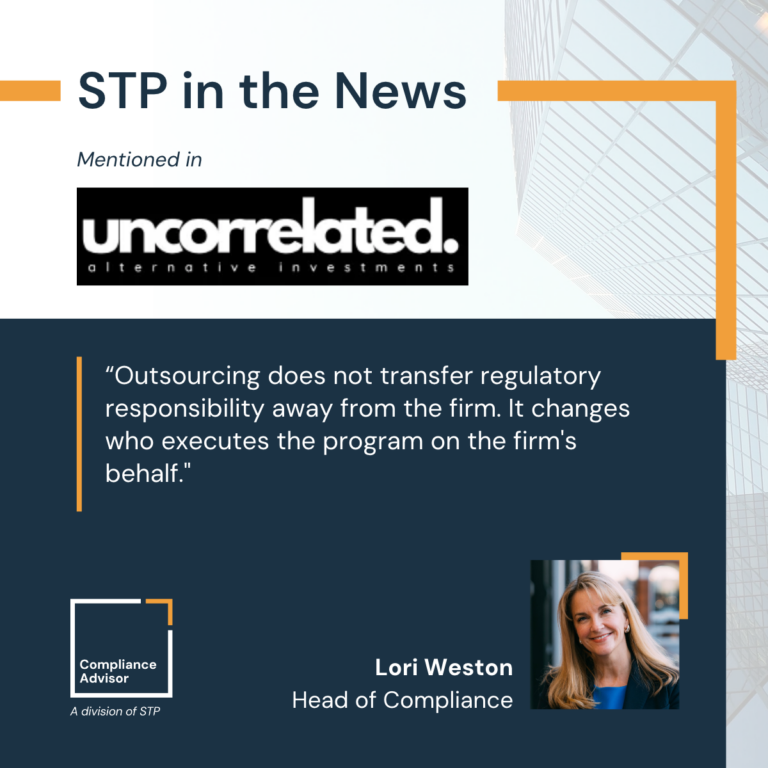
“Outsourcing does not transfer regulatory responsibility away from the firm. It changes who executes the program on the firm’s behalf.” – Lori Weston
That distinction is central to building a successful outsourced relationship. Regardless of who serves as CCO, the firm and its principals remain responsible for ensuring the compliance program is adequate and operational and for setting the appropriate tone from the top.
What This Means for Investment Advisers
An outsourced CCO arrangement can be particularly valuable when a firm does not have the resources for a dedicated senior compliance executive, experiences an unexpected leadership gap, or requires deeper expertise as its business becomes more complex.
But selecting a provider is only part of the process.
Firms should first understand their existing compliance obligations and identify gaps within the current program. From there, they can determine whether they need a fully designated outsourced CCO, specialized ongoing support, or a combination of internal and external resources.
Provider selection should also extend beyond cost. Regulatory experience, familiarity with the firm’s business model, the depth of the provider’s team, examination support capabilities, and the ability to scale are important considerations.
Once engaged, the outsourced CCO should be integrated into the organization rather than operating at arm’s length. Clear communication protocols, access to key personnel and records, regular meetings, escalation procedures, and documented oversight all contribute to a stronger and more defensible compliance program.
Action Steps for Investment Advisers
- Assess the current compliance program. Identify obligations, existing resources, and gaps requiring additional expertise or capacity.
- Determine the appropriate outsourcing model. Decide whether the firm requires a designated CCO, targeted compliance assistance, or a hybrid arrangement.
- Evaluate regulatory expertise. Consider providers with experience relevant to the firm’s registration, structure, strategy, and regulatory environment.
- Establish governance and communication protocols. Define meeting cadence, escalation procedures, regulatory updates, and management oversight.
- Integrate the CCO into operations. Provide access to the personnel, books and records, marketing materials, contracts, and information necessary to perform the role.
- Document ongoing oversight. Maintain records of meetings, reviews, findings, escalation, and remediation.
Frequently Asked Questions
What does it mean to outsource a Chief Compliance Officer?
An outsourced CCO is a qualified third-party professional engaged to design, implement, and administer an investment adviser’s compliance program. Depending on the arrangement, the outsourced CCO can be formally designated on the firm’s Form ADV.
Why might an investment adviser outsource its CCO?
The article identifies several common reasons, including limited internal resources, leadership or succession gaps, the need for deeper regulatory expertise, and the ability to scale compliance support as the firm grows.
Does outsourcing the CCO transfer regulatory responsibility?
No. The firm and its principals remain responsible for maintaining an adequate and operational compliance program and for providing appropriate oversight.
What should firms look for in an outsourced CCO provider?
Lori Weston recommends evaluating regulatory credentials, relevant industry expertise, program breadth, operational integration, scalability, and staffing continuity.
What is the difference between an outsourced CCO and ongoing compliance support?
A formally outsourced CCO assumes the designated CCO role and accountability for administering the program. Ongoing compliance support supplements an internal compliance function with services such as annual reviews, policy updates, Marketing Rule guidance, or mock examination preparation.
Can an investment adviser use a hybrid compliance model?
Yes. The article notes that the two approaches can coexist, allowing an internal CCO to retain the title while an external provider supplies additional expertise, capacity, and specialized oversight.
Why It Matters
Outsourcing the CCO function can provide investment advisers with regulatory expertise, continuity, and scalable compliance support, but the effectiveness of the model depends heavily on how it is implemented.
The strongest arrangements are not “set it and forget it” relationships. They combine experienced external compliance leadership with engaged firm management, clear governance, appropriate documentation, and meaningful integration into day-to-day operations.
For firms that take that approach, an outsourced CCO can become an important resource for strengthening regulatory readiness and building a compliance program capable of evolving alongside the business.