Asset Managers Set Sights on Front-Office Innovation
Asset managers are ramping up their artificial intelligence, data and operational capabilities this year to support the rollout of alternatives and other new products, according to SimCorp’s recent 2026 Global InvestOps report.
For the first time in two years, more than half of those polled, said technology and operations investments aimed at “innovation” is a top strategic priority this year to differentiate their firms in the market. Fewer, but still more than half, pointed to speeding up product launch dates, according to the report, which was produced with WBR Insights and surveyed 200 global buy-side operations leaders in the fourth quarter. Seventy percent of respondents said they have deployed AI to support front-office processes, compared to just 10% last year.
“It’s such a competitive landscape right now – investment managers are offering, generally, increasingly similar product suites,” said Pat Conroy, a vice president of global business development at STP Investment Services. “You have private markets shifting into the traditional markets. Portfolio management and trading have emerged as the primary differentiator.”
Adding AI capabilities in back- and middle-office functions had been “low-hanging fruit,” but now managers are applying AI in the front office to automate portfolio construction processes or customize portfolios to individual risk profiles in the wealth management channel, Conroy added.
Seventy-two percent said they are investing in generative AI and advanced analytics capabilities, which account for the bulk of managers’ tech spend. And investments in private markets technology specifically jumped from 27% in 2025 to 51% this year.
While nearly 58% of firms said they are consolidating their technology vendors and platforms, 63% said they still lack unified front-to-back data capabilities, which undermines AI readiness, according to the report.
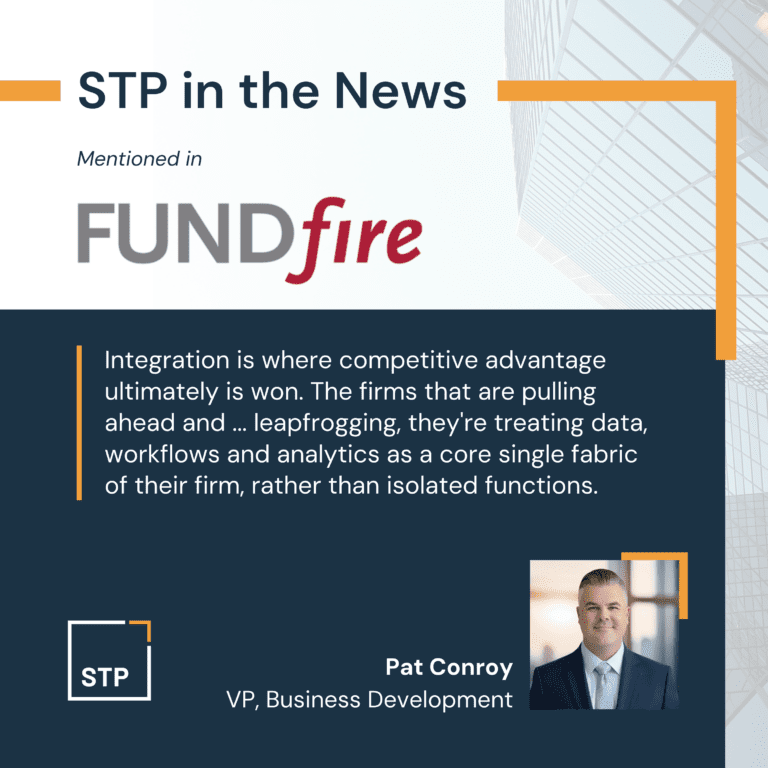
“That fragmented data is producing conflicting outputs, eroding confidence in AI models and efficiency models and automation models,” Conroy said. “Integration is where competitive advantage ultimately is won. The firms that are pulling ahead and … leapfrogging, they’re treating data, workflows and analytics as a core single fabric of their firm, rather than isolated functions.”
Read the full article in FundFire.