Are AI Super Users Driving Innovation or Creating New Risks?
Featured In: FundFire
Pat Conroy, Head of Strategy, Product & Transformation at STP Investment Services, was featured in a recent FundFire article examining the emergence of so-called “AI vampires”—professionals who become deeply immersed in learning, testing, and implementing artificial intelligence technologies within their organizations.
As investment firms continue accelerating AI adoption, industry leaders are debating where the line exists between healthy experimentation, operational innovation, and the potential for burnout. The discussion raises important questions about leadership, AI governance, workforce transformation, and organizational readiness.
Read the original article on FundFire.
The Bigger Picture
Artificial intelligence is rapidly transforming how financial services firms operate. From research and client service to compliance, operations, and software development, AI tools are helping teams automate tasks, improve productivity, and uncover new efficiencies.
As adoption accelerates, a growing group of professionals are becoming AI power users, spending significant time outside of traditional work hours exploring new tools, building workflows, testing use cases, and developing practical expertise.
While some observers have raised concerns about burnout and governance risks, others argue that hands-on experimentation is critical for responsible AI adoption. Organizations that expect employees to embrace AI may benefit when leaders personally invest time understanding both the capabilities and limitations of the technology.
The challenge for firms is determining how to foster innovation while maintaining appropriate governance, oversight, and employee well-being.
Key Takeaways
- AI adoption is accelerating across the investment management industry.
- Some professionals are dedicating significant personal time to learning and experimenting with AI.
- AI can increase productivity but may also contribute to longer working hours and burnout.
- Leadership involvement plays an important role in successful AI adoption.
- AI governance frameworks remain essential as firms deploy new technologies.
- Organizations must balance innovation, efficiency, risk management, and workforce sustainability.
Pat Conroy’s Perspective
As highlighted in the article, leadership engagement may be one of the most important factors in successful AI implementation.
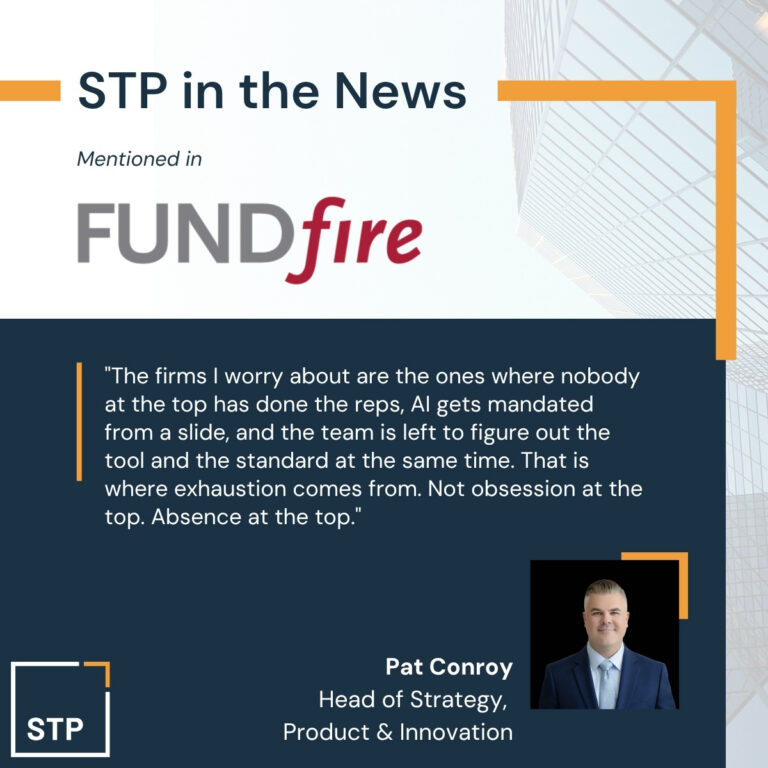
“The vampire framing gets the risk backwards. The firms I worry about are the ones where nobody at the top has done the reps, AI gets mandated from a slide, and the team is left to figure out the tool and the standard at the same time. That is where exhaustion comes from. Not obsession at the top. Absence at the top.”
— Pat Conroy, Head of Strategy, Product & Transformation, STP Investment Services
Conroy’s perspective highlights a growing realization across the industry: organizations may be more successful when executives actively engage with AI rather than treating implementation solely as a technology initiative. Leaders who understand the tools firsthand are often better positioned to establish realistic expectations, effective governance, and practical use cases.
What This Means for Investment Firms
The conversation around AI is evolving beyond simple productivity gains.
Today, firms are asking deeper questions about workforce readiness, governance models, operating structures, and the future role of human expertise. While AI can dramatically improve efficiency, successful implementation requires more than simply purchasing technology licenses.
Organizations must create environments where experimentation is encouraged but structured. Employees need clear guidance regarding approved use cases, governance expectations, data security requirements, and risk management protocols.
Leadership involvement is equally important. Firms that rely solely on top-down mandates may struggle to gain adoption if executives lack firsthand experience with the technology. Conversely, organizations where leaders are actively exploring AI may be better positioned to identify meaningful opportunities and understand potential risks.
Ultimately, successful AI strategies will likely blend innovation with accountability, creating cultures where curiosity is encouraged while governance standards remain strong.
Action Steps for Business Leaders
- Encourage hands-on AI learning among leadership teams.
- Establish clear AI governance and usage policies.
- Provide training that focuses on practical business applications.
- Monitor employee workload to prevent burnout and technology fatigue.
- Create structured forums for sharing successful AI use cases across teams.
- Evaluate AI initiatives based on measurable business outcomes rather than novelty.
Frequently Asked Questions
What is an AI super user?
An AI super user is an individual who actively experiments with, learns about, and deploys AI tools at a significantly higher rate than their peers.
Why are firms encouraging AI adoption?
Organizations are using AI to improve productivity, automate repetitive tasks, enhance decision-making, and create operational efficiencies.
Can AI increase employee burnout?
Research discussed in the article suggests AI can increase productivity while also expanding workloads, potentially contributing to fatigue if not managed appropriately.
Why is leadership involvement important?
Leaders who understand AI firsthand are often better equipped to guide implementation, manage risk, and establish realistic expectations.
What role does AI governance play?
AI governance helps organizations establish policies, oversight mechanisms, security controls, and accountability structures to support responsible use.
How can firms balance innovation and risk?
Successful firms typically combine experimentation and learning with governance frameworks, training programs, and clear operational standards.
Why It Matters
AI is rapidly becoming a competitive differentiator across financial services, but technology alone does not drive transformation. The organizations that gain the most value from AI will be those that combine leadership engagement, employee education, strong governance, and practical business application. As firms continue navigating this transition, the goal is not simply adopting AI faster—it is adopting it responsibly, effectively, and sustainably.