The AI Model Race Is Accelerating. How Should Asset Managers Respond?
Featured In: FundFire
Pat Conroy, Head of Strategy, Product & Innovation at STP Investment Services, was featured in a recent FundFire article examining how asset managers are responding to the rapid introduction of new and increasingly sophisticated AI models.
As firms evaluate frontier and open-weight models for applications ranging from investment research to reconciliation, the challenge is shifting from simply adopting AI to determining which models make sense for specific workflows while managing cost, governance, data protection, and infrastructure requirements.
Read the original article on FundFire.
The Bigger Picture
The AI market is evolving quickly, creating both opportunities and challenges for investment managers.
Firms now have access to frontier models such as OpenAI’s GPT offerings, Anthropic’s Claude, and Google’s Gemini, alongside open-weight alternatives such as Meta’s Llama and DeepSeek. Each offers different considerations around capability, customization, cost, and implementation.
According to the article, many managers currently favor frontier models for sophisticated applications such as agentic workflows, research, investment memo drafting, and quantitative coding. At the same time, open-weight models are increasingly being considered for more routine, high-volume tasks where firms may not need to pay for frontier-level capabilities.
That creates a more nuanced AI strategy. Rather than selecting one model and attempting to apply it everywhere, firms are increasingly evaluating specific models based on the requirements of each workflow.
The result is an emerging multi-model environment where data architecture, governance, and the ability to adapt may matter just as much as the model itself.
Key Takeaways
- Asset managers are navigating an increasing number of AI model choices.
- Frontier models can be well suited for complex reasoning, research, coding, and agentic workflows.
- Open-weight models may offer advantages for routine, high-volume processes where frontier capabilities are unnecessary.
- AI costs remain an important consideration as firms scale usage.
- Flexible infrastructure can allow firms to adapt as new and improved models enter the market.
- Strong AI governance, data protections, and human oversight remain essential as AI becomes embedded in investment workflows.
Pat Conroy’s Perspective
Pat highlighted the distinction between where firms are currently using frontier models and where open-weight models may provide a compelling alternative.
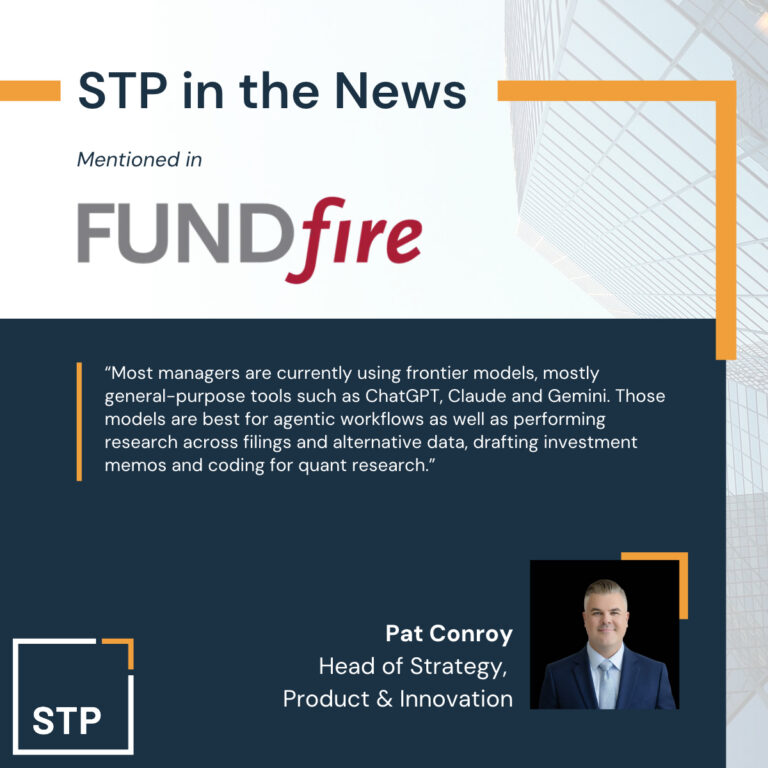
According to Pat, most asset managers are currently using general-purpose frontier models such as ChatGPT, Claude, and Gemini. These models can support more sophisticated applications including agentic workflows, research across filings and alternative data, investment memo drafting, and coding for quantitative research.
For routine, high-volume work, however, firms may not always need those capabilities.
“Routine work nobody wants to pay frontier prices for.”
— Pat Conroy, Head of Strategy, Product & Innovation, STP Investment Services
Pat pointed to activities such as document classification, capital call notices, and reconciliations as examples of workflows where open-weight models may offer an attractive alternative.
What This Means for Asset Managers
The rapid pace of AI development creates a temptation for organizations to continually reassess their technology stack each time a new model arrives.
A more sustainable approach may be to focus on the underlying use case first.
Complex research, agentic workflows, quantitative development, and reasoning-intensive activities may justify the capabilities and cost of frontier models. More repetitive and high-volume operational workflows may have different requirements.
This distinction becomes increasingly important as AI usage scales. Managers must consider not only model performance, but also cost, data security, governance, integration requirements, and how easily models can be changed as technology evolves.
The article also highlights the importance of architecture. Firms that build systems capable of swapping models in and out may be better positioned to take advantage of future improvements without having to redesign entire workflows around each new release.
In that environment, the competitive advantage may not come from adopting the newest model first. It may come from creating an operating model that can consistently evaluate and adopt the technology best suited to the job.
Action Steps for Operations and Technology Leaders
- Categorize AI use cases based on complexity, risk, volume, and business impact.
- Evaluate whether each workflow genuinely requires frontier-model capabilities.
- Track AI costs as usage moves from pilots into production.
- Build architecture with enough flexibility to evaluate different models over time.
- Establish governance standards that apply consistently across AI models and providers.
- Maintain appropriate data protections when working with third-party AI platforms.
- Keep human oversight embedded in higher-risk and decision-oriented workflows.
Frequently Asked Questions
What is a frontier AI model?
Frontier models are highly advanced, general-purpose AI models offered by providers such as OpenAI, Anthropic, and Google. The article notes that asset managers use them for sophisticated applications including agentic workflows, research, investment memo drafting, and coding.
What is an open-weight AI model?
Open-weight models make their model weights available and can offer firms greater opportunities for customization and control. The article identifies Meta’s Llama and DeepSeek among examples being considered in the industry.
When might an asset manager use an open-weight model?
Pat identifies high-volume activities including document classification, capital call notices, and reconciliations as examples where firms may not need to pay for frontier-model capabilities.
Why are AI costs becoming an issue?
As firms move from experimentation toward large-scale production use, model consumption and associated token costs can increase significantly. FundFire previously reported that managers are grappling with growing AI bills as adoption expands.
Should firms standardize on one AI model?
The article describes industry leaders emphasizing infrastructure that allows firms to use different tools and potentially swap models as technology evolves. A multi-model strategy can help organizations evaluate technology according to individual business requirements.
Why does AI governance remain important?
As models become embedded in investment and operational workflows, firms still need appropriate controls around data, oversight, security, and model use. STP’s existing AI thought leadership has similarly emphasized that adoption works best when accountability and human oversight are designed into workflows.
Why It Matters
The pace of AI development is unlikely to make technology decisions simpler. Instead, investment managers will have more models, capabilities, providers, and cost structures to evaluate.
The goal should not be to adopt every new model that reaches the market. Firms need a framework for determining which capabilities actually solve a business problem and an architecture flexible enough to evolve as better options become available.
For asset managers, AI readiness is increasingly about optionality: the ability to use the right model, for the right task, at the right cost, with the right governance.