Agentic AI Moves From Experimentation to Investment Operations
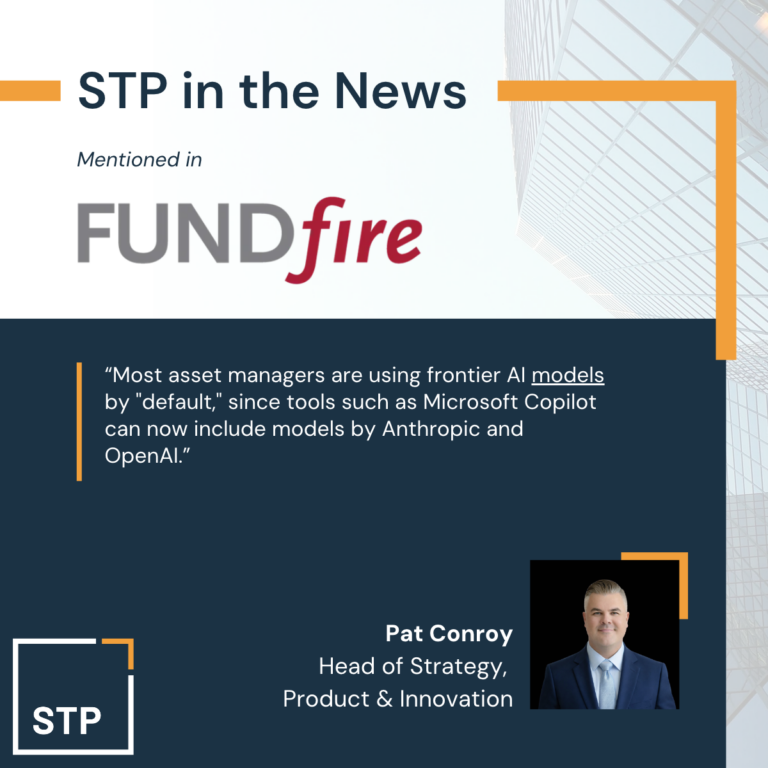
Featured In: FundFire
Pat Conroy, Head of Strategy, Product & Innovation at STP Investment Services, was featured in a recent FundFire article examining Northern Trust Asset Servicing’s deployment of an AI-powered client onboarding agent developed with Microsoft.
The implementation demonstrates how agentic AI can address data-intensive operational processes while maintaining human review, privacy, security, and governance controls. Northern Trust and Microsoft report that the technology reduced onboarding data preparation time by 83%, from approximately two and a half weeks to three days. [news.microsoft.com], [northerntrust.com]
Read the original article on FundFire.
The Bigger Picture
Institutional client onboarding can involve years of transaction history, investment data, cash flows, and information arriving from multiple sources and in different formats. The challenge becomes particularly complicated for portfolios with significant allocations to alternative assets. [news.microsoft.com]
Northern Trust and Microsoft targeted this operational bottleneck with an AI agent designed to transform historical transaction data into Northern Trust’s standardized format.
The reported results are significant. Data preparation time fell by 83%, and the agent achieved a 96.5% F1 first-pass quality score in testing. Importantly, human oversight remains embedded throughout the workflow. Analysts review outputs, resolve exceptions, and approve the work prior to completion.
For investment operations leaders, the implementation illustrates an important shift. AI adoption is moving beyond broad productivity tools and into highly specific operational workflows where success can be measured in time saved, data quality, exception management, and capacity created for higher-value work.
Key Takeaways
- Agentic AI is moving into real-world investment operations workflows.
- Northern Trust and Microsoft report an 83% reduction in onboarding data preparation time. [news.microsoft.com]
- The agent achieved a 96.5% F1 first-pass quality score during testing. [northerntrust.com]
- Human review remains part of the process, particularly for exceptions and final approval. [news.microsoft.com]
- Data-intensive processes involving alternatives can present particularly compelling opportunities for automation.
- Firms do not necessarily need the newest or most advanced AI model for every operational use case.
- Governance, data protection, and model selection should remain integral to implementation.
Pat Conroy’s Perspective
Pat’s comments highlight an important reality about AI model selection.
According to Pat, many asset managers use frontier AI models by default as enterprise platforms increasingly provide access to models from providers such as Anthropic and OpenAI.
But that does not mean every investment operations workflow requires the most advanced model available.
For repetitive, structured, or back-office processes, the better question may be whether a model is sufficiently capable, reliable, governable, and cost-effective for the specific task.
That distinction becomes increasingly important as investment firms move from AI pilots into production and begin evaluating the long-term cost and operational requirements of AI at scale.
What This Means for Investment Operations Leaders
Northern Trust’s implementation provides a useful example of how investment firms can identify potential AI opportunities.
Rather than beginning with the technology and searching for problems it can solve, firms can start with an existing operational bottleneck: a process that is manual, time intensive, data heavy, repetitive, or prone to exceptions.
Client onboarding fits that profile particularly well.
The challenge is not simply automating the entire process. A more practical approach can involve allowing AI to handle repeatable data transformation and classification while experienced professionals remain responsible for reviewing outputs, resolving exceptions, and approving results.
The approach can also help preserve institutional knowledge. Subject-matter expertise that traditionally exists in employees’ heads can increasingly be incorporated into rules, workflows, and automated processes.
For operations teams, this creates an opportunity to rethink how people spend their time. If AI handles repetitive data preparation effectively, experienced professionals can dedicate greater attention to exceptions, analysis, client service, and other activities requiring judgment.
Action Steps for Operations and Technology Leaders
- Identify measurable operational bottlenecks. Look first at repetitive, data-intensive processes such as onboarding, classification, reconciliation, or document processing.
- Match model capability to the workflow. Avoid assuming every use case requires the newest frontier model.
- Establish a human-in-the-loop process. Define who reviews outputs, handles exceptions, and remains accountable for final approval.
- Set measurable performance standards. Track processing time, accuracy, exception rates, costs, and quality before and after implementation.
- Protect client data. Define how data is accessed, processed, retained, and used by AI systems and third-party providers.
- Build governance into the workflow. Treat oversight as part of the design rather than something added after deployment.
- Capture subject-matter expertise. Identify institutional knowledge that can be translated into repeatable rules and workflows.
Frequently Asked Questions
How can agentic AI be used in investment operations?
Agentic AI can support structured, data-heavy workflows such as onboarding, document classification, reconciliations, data mapping, research, and exception identification.
How much did AI reduce Northern Trust’s onboarding time?
Northern Trust and Microsoft report that the onboarding agent reduced data preparation time by 83%, from approximately two and a half weeks to three days. [news.microsoft.com]
Does the AI agent replace human analysts?
No. Analysts remain responsible for reviewing the agent’s outputs, resolving exceptions, and approving its work. [news.microsoft.com]
Do operational AI applications require frontier models?
Not necessarily. Model selection should depend on the complexity and requirements of the specific use case. More routine operational tasks may not require the capabilities or associated costs of the newest frontier models.
Why is human oversight important in agentic AI?
Human review can provide additional control over exceptions, unexpected outputs, and decisions requiring business judgment. Northern Trust specifically designed its onboarding workflow with human oversight throughout the process. [news.microsoft.com]
What should firms evaluate before deploying AI?
Firms should consider the business problem, expected ROI, data requirements, security, governance, human oversight, model capability, integration needs, and ongoing operating costs before moving a use case into production.
Why It Matters
Investment management is entering a stage of AI adoption where measurable operational outcomes matter more than experimentation alone.
Northern Trust’s onboarding implementation provides a concrete example: a narrowly defined operational problem, specialized AI capabilities, measurable efficiency improvements, and human oversight embedded throughout the workflow.
For asset managers and service providers, the lesson is not that every operation needs an AI agent. It is that the strongest AI opportunities may be found in processes where repetitive work can be automated while experienced professionals remain responsible for judgment, exceptions, and control.
The firms that get this balance right can use AI not simply to automate work, but to redesign how investment operations are delivered.