Economic Conflicts Take Center Stage in the SEC’s 2027 Exam Priorities
Featured In: A-Team Insight
Lori Weston, Head of Compliance at STP Investment Services, was featured in a recent A-Team Insight article examining several key areas within the SEC’s Fiscal Year 2027 Examination Priorities, including economic conflicts, private assets, technology oversight, Regulation S-P, and evolving market infrastructure.
The priorities reinforce the SEC’s focus on investment advisers’ fiduciary obligations and conflicts of interest while also addressing private funds, emerging technologies, cybersecurity, and operational resilience.
Read the original article on A-Team Insight.
The Bigger Picture
The SEC’s 2027 examination priorities cover a broad range of risks facing investment advisers and other registrants, but several themes are particularly relevant for compliance teams.
Economic conflicts are one notable area. According to A-Team Insight, examiners will consider fee rebates, cash management, deposits, withdrawals, and quid pro quo arrangements when assessing whether financial conflicts could affect the impartiality of an adviser’s recommendations.
Private funds and illiquid investments represent another focus. Examinations may consider debt and fund-level lines of credit, affiliated service providers, investment allocations, and fees and expenses at both the fund and investment level.
Technology oversight continues to expand as well. The SEC’s official priorities identify emerging technologies, cybersecurity, operational resilience, and protection of customer information among its FY 2027 focus areas.
Taken together, these themes point toward an increasingly interconnected compliance environment in which operational decisions, business changes, technology use, and financial arrangements can all create compliance implications.
Key Takeaways
- Economic conflicts and investment adviser fiduciary obligations remain important areas of examination attention.
- Indirect compensation arrangements, including sweep programs and cash allocations, may warrant closer compliance review.
- Private-fund examinations may scrutinize fees, expenses, affiliated service providers, investment allocations, and fund-level financing arrangements.
- Technology oversight extends to emerging technology as well as cybersecurity and protection of customer information.
- Regulation S-P examinations are shifting toward implementation, including customer information safeguards and service-provider oversight.
- Firms undergoing changes to client types, services, or business models should consider how those changes affect compliance programs, conflicts, and risk assessments.
Lori Weston’s Perspective
Lori Weston emphasized that some of the most important economic conflicts may arise from compensation arrangements that can be overlooked because they appear operational in nature.
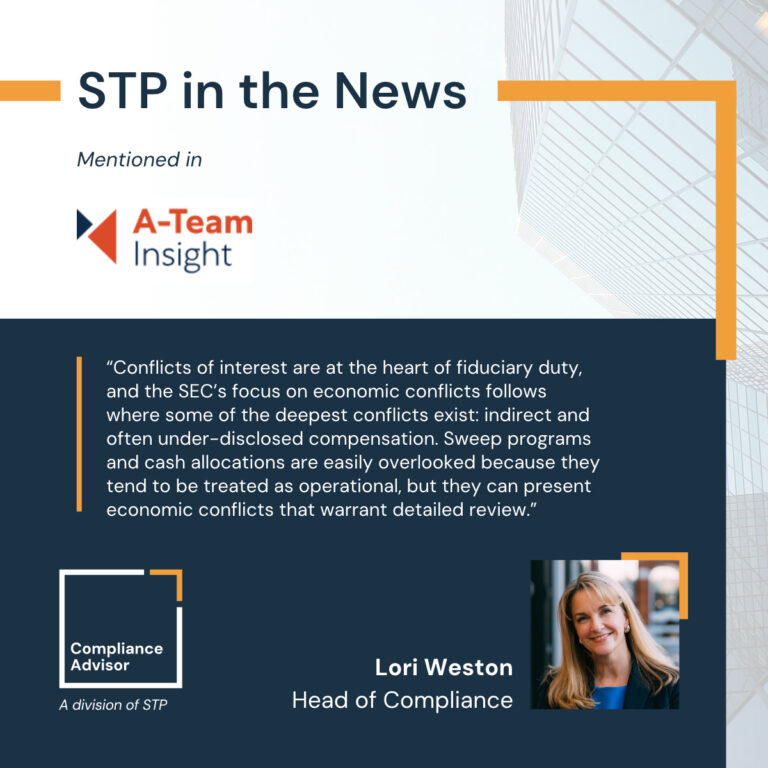
“Conflicts of interest are at the heart of fiduciary duty, and the SEC’s focus on economic conflicts follows where some of the deepest conflicts exist: indirect and often under-disclosed compensation. Sweep programs and cash allocations are easily overlooked because they tend to be treated as operational, but they can present economic conflicts that warrant detailed review.”
— Lori Weston, Head of Compliance, STP Investment Services
That distinction is important. A process that appears operational can still create an economic incentive or conflict that should be identified, evaluated, and addressed within a firm’s compliance framework.
What This Means for Investment Advisers
The 2027 priorities provide firms with an opportunity to look beyond whether policies exist and evaluate whether their compliance programs accurately reflect how the business operates today.
For conflicts of interest, that could mean reviewing sources of direct and indirect compensation and considering whether existing disclosures, policies, and monitoring capture economic relationships that could affect advice.
Private fund advisers face additional considerations around valuation, fees and expenses, allocation practices, affiliated service providers, and the use of leverage or fund-level credit facilities. A-Team Insight notes that fees and expenses are receiving attention at both the fund and individual investment levels.
Technology adds another layer. Emerging technologies and third-party systems can affect recordkeeping, customer information, cybersecurity, and operational resilience. The SEC’s official 2027 priorities explicitly identify emerging technologies and protection of customer information among its examination focus areas.
Perhaps most importantly, compliance programs should not remain static while businesses evolve.
Preparing for Business Change
As highlighted in A-Team Insight, Lori Weston specifically addressed firms that have introduced new client types or services:
“The Division’s focus on advisers that have added new client types or services shows these areas of change are not a fleeting concern. Firms in these categories should carefully evaluate how the change affects their compliance program, risk assessment, and conflicts, document that analysis, and reflect it in their next annual compliance review.”
— Lori Weston, Head of Compliance, STP Investment Services
This provides firms with a useful lens for examination readiness: significant business changes should be evaluated not only commercially or operationally, but also through the compliance and risk-management framework.
Action Steps for Compliance Leaders
Based on the areas highlighted in the 2027 priorities, firms may want to consider:
- Reviewing direct and indirect compensation arrangements for potential economic conflicts.
- Evaluating sweep programs, cash allocations, fees, and expense practices.
- Reviewing private-fund controls involving affiliated providers, allocations, and fund-level financing.
- Assessing third-party technology and customer-information risks.
- Reviewing Regulation S-P implementation and service-provider oversight.
- Documenting how new services, client types, or other material business changes affect compliance risks and conflicts.
- Incorporating relevant business changes and identified weaknesses into the annual compliance review.
These are practical considerations based on the published priorities and commentary, not new regulatory obligations created by the priorities themselves. The SEC notes that its examination priorities do not alter applicable law or create new obligations.
Frequently Asked Questions
What economic conflicts are highlighted in the SEC’s 2027 priorities?
The article identifies areas including fee rebates, fee and expense calculations, cash management, deposits, withdrawals, and quid pro quo arrangements.
Why are sweep programs relevant to conflicts of interest?
Lori Weston noted that sweep programs and cash allocations can be overlooked because they are often treated as operational, despite potentially presenting economic conflicts requiring review.
What private-fund areas may receive examination attention?
The article highlights fund-level debt and lines of credit, affiliated service providers, investment allocations, and fee and expense calculations at both fund and investment levels.
How does technology factor into the 2027 priorities?
The SEC identifies emerging technologies, operational resiliency, cybersecurity, and customer-information protections among its focus areas.
What changed around Regulation S-P?
According to A-Team Insight, the 2027 emphasis moves toward implementation, including safeguards for customer information, incident response, customer notification, and service-provider oversight.
Why should firms reassess compliance after business changes?
Lori Weston recommends that firms adding new client types or services evaluate the resulting impact on their compliance programs, risk assessments, and conflicts and document that analysis.
Why It Matters
The SEC’s 2027 Examination Priorities reinforce that examination readiness cannot be separated from a firm’s underlying operations.
Economic arrangements can create conflicts. Private-market growth can introduce new valuation and fee considerations. New technologies can change information-security and recordkeeping risks. New products, services, and client types can alter a firm’s overall risk profile.
For compliance teams, the common thread is adaptability. Firms should be able to demonstrate not only that policies and controls exist, but that their compliance programs continue to evolve as their businesses do.