What the SEC’s Proposed Pay-to-Play Rule Repeal Means for Investment Advisers
Featured In: FundFire
Lori Weston, Head of Compliance at STP Investment Services, was featured in a recent FundFire article examining the SEC’s proposal to rescind its Pay-to-Play Rule. Originally adopted in 2010, the rule was designed to prevent investment advisers from influencing government contract awards through political contributions. The proposed repeal could significantly reshape compliance obligations for registered investment advisers and firms that work with government entities.
The Bigger Picture
For more than a decade, the SEC’s Pay-to-Play Rule has regulated political contributions by investment advisers and imposed restrictions on firms seeking government-related investment mandates. The rule established contribution limits, lookback provisions, and potential two-year restrictions that could prevent firms from receiving advisory fees or pursuing government business after certain political contributions were made.
The SEC’s proposal would eliminate the rule entirely, including associated recordkeeping requirements. According to SEC Chair Paul Atkins, the regulation is overly prescriptive, creates unintended consequences, and may discourage political participation by industry professionals. The SEC also stated that existing anti-fraud provisions, compliance rules, and codes of ethics would continue to provide safeguards against improper conduct.
If adopted, the repeal could reduce administrative burdens for advisers while requiring firms to reassess how they manage political contributions, conflicts of interest, and reputational risk.
Key Takeaways
- The SEC has proposed rescinding the Pay-to-Play Rule in its entirety.
- The proposal would eliminate contribution thresholds, lookback provisions, and certain recordkeeping requirements.
- Existing anti-fraud rules and adviser compliance obligations would remain in place.
- Many advisers have historically implemented broad pre-clearance or contribution restrictions to manage compliance risk.
- Firms may need to establish their own policies for monitoring political contributions if the rule is removed.
- The proposal has implications for compliance programs, hiring practices, and government-related business development activities.
Lori Weston’s Perspective
As highlighted in the article, many firms addressed the rule’s complexity by implementing broad restrictions on employee political contributions rather than attempting to track every covered associate and lookback period.
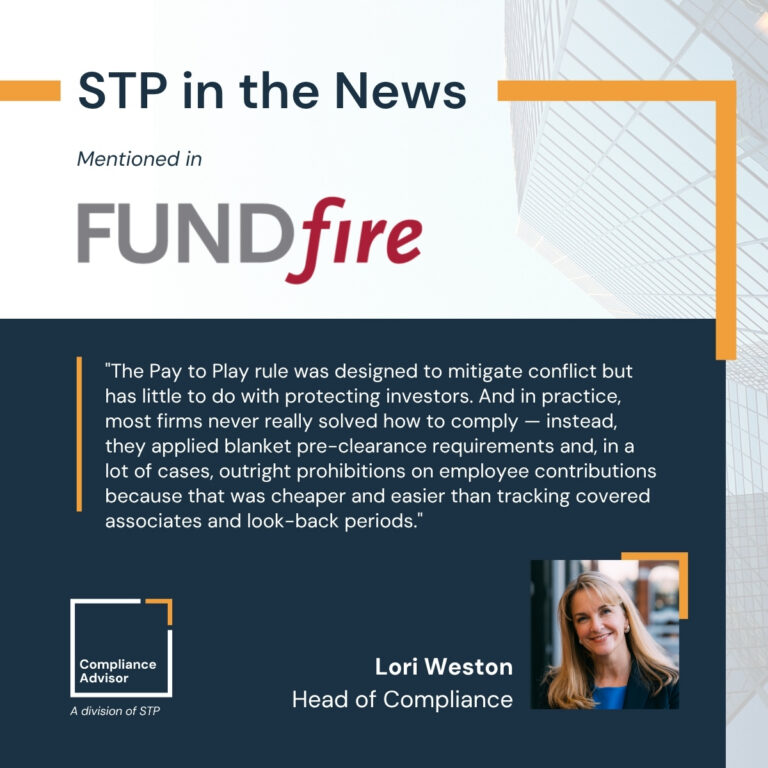
“The Pay to Play rule was designed to mitigate conflict but has little to do with protecting investors. And in practice, most firms never really solved how to comply — instead, they applied blanket pre-clearance requirements and, in a lot of cases, outright prohibitions on employee contributions because that was cheaper and easier than tracking covered associates and look-back periods.”
— Lori Weston, Head of Compliance, STP Investment Services
Weston’s comments highlight a broader industry challenge: balancing conflict-of-interest controls with operational practicality and employee participation in the political process.
What This Means for Investment Advisers
For many advisers, the Pay-to-Play Rule became one of the more administratively complex compliance requirements within the Investment Advisers Act framework.
If the rule is rescinded, firms could see meaningful reductions in compliance monitoring and recordkeeping activities. Human resources, compliance, and legal departments may also face fewer challenges when evaluating employee contributions made before joining a firm or before moving into covered positions.
However, the repeal would not eliminate the underlying risks that originally led to the rule’s creation. Firms that pursue public pension mandates or government-related investment business will still need policies and procedures designed to identify conflicts, protect against misconduct, and preserve client trust.
Many organizations may ultimately choose to maintain some form of political contribution review process even if regulatory requirements are relaxed. Strong governance frameworks, transparency, and documented oversight procedures will likely remain important components of a mature compliance program.
Action Steps for Compliance Leaders
- Monitor developments related to the SEC’s proposed Pay-to-Play Rule repeal.
- Review existing political contribution policies and procedures.
- Evaluate whether current pre-clearance requirements remain appropriate if the rule is rescinded.
- Assess governance controls surrounding government-related business development.
- Maintain documentation and oversight practices that help identify potential conflicts of interest.
Frequently Asked Questions
What is the SEC Pay-to-Play Rule?
The rule restricts certain political contributions by investment adviser personnel and limits advisory business with government entities under specific circumstances.
Why is the SEC proposing to eliminate the rule?
According to the SEC, the rule is overly complex, creates unintended consequences, and may unnecessarily restrict political participation.
Would anti-fraud protections still apply?
Yes. The SEC stated that existing anti-fraud provisions, compliance rules, and codes of ethics would remain in effect.
How has the rule impacted advisers?
Many firms implemented extensive monitoring systems, pre-clearance programs, and contribution restrictions to reduce compliance risk.
What should firms do if the rule is repealed?
Firms should evaluate whether internal policies remain sufficient to address conflicts of interest, government relationships, and reputational risks.
Why It Matters
The SEC’s proposal to rescind the Pay-to-Play Rule represents a potentially significant shift in how political contribution oversight is regulated within the investment management industry. While many firms may welcome reduced compliance burdens, the change also places greater responsibility on advisers to maintain appropriate governance and conflict management practices. Organizations that proactively assess their compliance frameworks and establish clear policies will be better positioned to navigate any future regulatory changes.