Why Continuation Vehicles Are Reshaping Private Markets
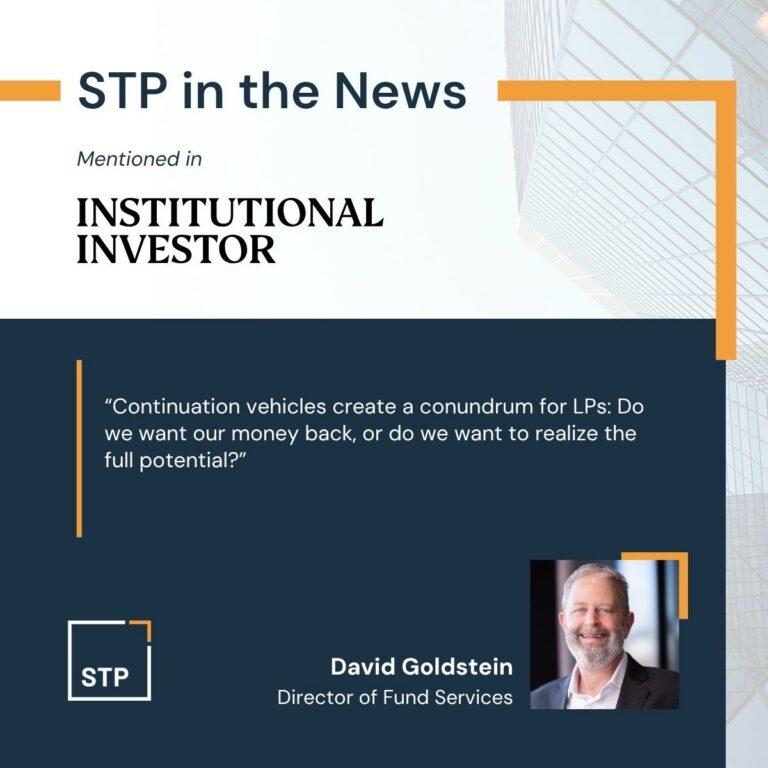
Featured In: Institutional Investor
, Director of Product & Fund Services at STP Investment Services, was featured in a recent Institutional Investor article examining the growing use of continuation vehicles as private equity firms face ongoing challenges with liquidity and exits. As managers seek alternatives to selling portfolio companies at discounted valuations, continuation vehicles are increasingly being used to extend ownership while providing liquidity options for investors.
The Bigger Picture
Private equity firms have traditionally relied on portfolio company exits to return capital to investors within expected fund timelines. However, difficult market conditions and slower exit activity have disrupted that model, leaving many investors waiting longer than anticipated for distributions.
As a result, continuation vehicles have grown significantly in popularity. According to data cited in Institutional Investor, global continuation funds raised nearly $63 billion in 2025, the highest annual total since at least 2017, while the number of closed continuation funds reached an eight-year high.
Rather than selling assets at valuations managers consider unfavorable, continuation vehicles provide a mechanism to extend ownership, preserve upside potential, and provide liquidity options to investors seeking cash. While this structure offers flexibility, it also creates new considerations around alignment, fees, governance, and investor choice.
Key Takeaways
- Continuation vehicles are becoming increasingly common across private markets.
- Challenging exit conditions are contributing to longer holding periods for private equity investments.
- Managers are using continuation vehicles to maintain ownership of assets they believe still have growth potential.
- Limited partners are being asked to evaluate liquidity needs versus future upside potential.
- Investor scrutiny around fees, governance, and alignment continues to increase.
David Goldstein’s Perspective
As highlighted in the article, continuation vehicles have become increasingly common as private equity firms face extended holding periods and slower exits.
“They’re creating continuation vehicles, and the uptick has significantly outpaced what it has been in the past. I read about a CV almost every day now.”
— , Director of Product & Fund Services, STP Investment Services
Goldstein also noted that many private equity funds are holding assets longer than investors originally anticipated. In some cases, investors who expected a seven- to ten-year investment horizon are finding themselves committed for significantly longer periods, contributing to growing demand for liquidity solutions.
What This Means for Private Equity Managers
Continuation vehicles have evolved well beyond their original role as niche liquidity solutions. They are increasingly becoming strategic portfolio management tools that allow managers to maintain exposure to attractive assets while addressing investor liquidity concerns.
For managers, continuation vehicles can create flexibility in difficult market environments and help avoid forced sales at discounted valuations. However, they also introduce heightened scrutiny from investors who are increasingly focused on transparency, economics, governance, and alignment of interests.
Limited partners face a different challenge. Continuation vehicles often require investors to choose between realizing liquidity today or remaining invested in pursuit of additional value creation. As these structures become more common, both GPs and LPs will need to carefully evaluate how continuation vehicles fit within broader portfolio objectives and liquidity planning.
The firms that execute these transactions successfully will likely be those that prioritize transparency, investor communication, operational excellence, and alignment throughout the process.
Action Steps for Fund Managers
- Review governance frameworks surrounding continuation vehicle transactions.
- Strengthen investor communication and disclosure practices.
- Evaluate liquidity planning across fund structures.
- Assess operational capabilities needed to support increasingly complex transactions.
- Focus on alignment between GP objectives and LP expectations throughout the transaction lifecycle.
Frequently Asked Questions
What is a continuation vehicle?
A continuation vehicle is a structure that allows a private equity manager to transfer one or more assets into a new fund, extending ownership while providing liquidity options to existing investors.
Why are continuation vehicles becoming more popular?
Slower exit activity and liquidity challenges across private markets have encouraged managers to use continuation vehicles as an alternative to traditional asset sales.
How do continuation vehicles benefit fund managers?
They can help managers maintain ownership of attractive assets, avoid discounted exits, and potentially create additional value over time.
Some investors view them as shifting costs, risks, or difficult liquidity decisions onto LPs, while others question whether incentives remain properly aligned.
What should investors consider when evaluating a continuation vehicle?
Investors should carefully assess liquidity needs, governance structures, fees, valuation processes, and long-term return expectations.
Why It Matters
Continuation vehicles are no longer a niche private equity solution. They have become an important response to ongoing liquidity challenges throughout private markets. As holding periods lengthen and exit activity remains constrained, these structures are likely to play an increasingly important role in how managers and investors approach portfolio management, capital planning, and value creation. Success will depend not only on the quality of the underlying assets but also on maintaining transparency, trust, and alignment between managers and investors.