AI Has Changed the Buy vs. Build Decision
AI Has Changed the Buy vs. Build Decision
By Pat Conroy, Head of Strategy, Product & Innovation, STP Investment Services
Technology leaders have debated whether to buy or build for decades. But the rise of artificial intelligence has fundamentally changed the question.
Historically, firms evaluated technology decisions based on implementation costs, timelines, internal resources, and strategic priorities. Today, AI introduces an entirely new set of considerations, including governance, iteration velocity, talent requirements, maintenance obligations, and long-term organizational readiness.
As investment firms accelerate AI adoption, leaders must carefully evaluate not only what they are building, but what they are committing to own.
The Bigger Picture
Artificial intelligence has dramatically lowered barriers to development. Modern foundation models, AI copilots, and automation tools make it easier than ever for firms to create internal applications and workflow enhancements.
At the same time, many organizations underestimate the complexity associated with deploying and maintaining AI-powered systems at scale. Industry data shows that a significant percentage of AI projects never reach production, resulting in substantial costs and delayed value realization.
For investment managers, the challenge extends beyond building a tool. Firms must determine whether they have the capabilities, governance structures, talent, infrastructure, and operational support necessary to maintain those solutions over time.
This distinction is particularly important for mid-market investment firms, where resources are often more limited and technology investments must deliver measurable outcomes.
Key Takeaways
- AI has lowered the technical barriers to building internal tools.
- Many firms underestimate the long-term costs associated with maintaining AI solutions.
- Not all AI use cases should be evaluated through the same buy-versus-build framework.
- Internal development may be appropriate for productivity and workflow enhancement tools.
- Mission-critical systems often require deeper governance, testing, maintenance, and support.
- Organizational readiness may be more important than technological capability alone.
Pat Conroy’s Perspective
As organizations evaluate AI opportunities, the question is no longer simply whether something can be built internally.
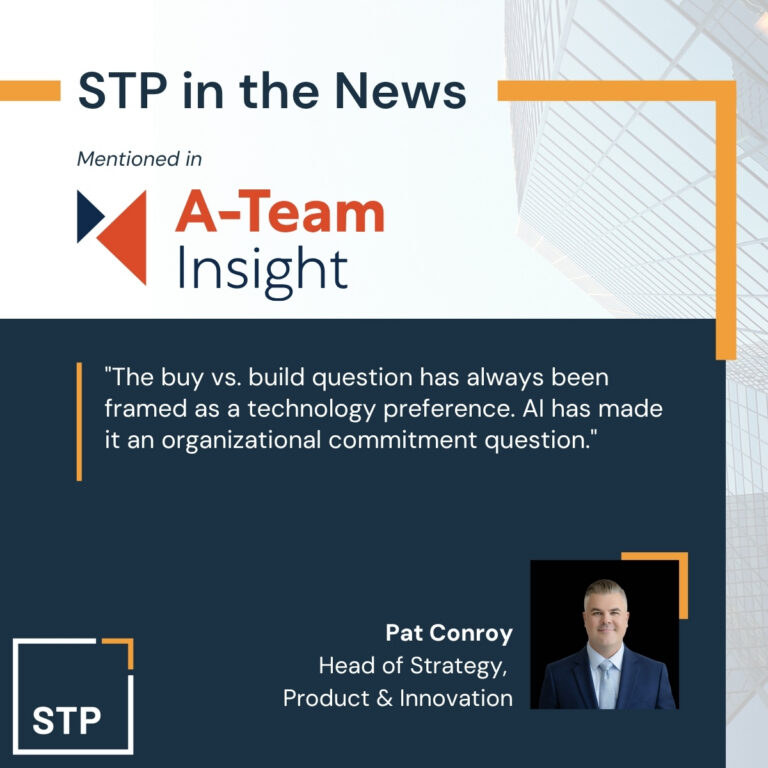
“The buy vs. build question has always been framed as a technology preference. AI has made it an organizational commitment question.”
— Pat Conroy, Head of Strategy, Product & Innovation, STP Investment Services
According to Conroy, firms often focus on the upfront cost difference between buying and building while underestimating the ongoing investments required to maintain AI systems, govern model performance, manage evolving infrastructure, and support future iterations.
What This Means for Investment Operations Leaders
For many investment operations teams, AI presents a unique opportunity to improve efficiency, automate routine tasks, and enhance client service.
However, not every use case warrants internal development.
Operational productivity tools, workflow automation, knowledge management solutions, and process enhancements can often be built quickly and cost-effectively using modern AI technologies. These projects typically involve limited risk, shorter feedback cycles, and constrained operational impact.
Mission-critical functions present a different challenge. Systems that support investment decisions, client-facing outputs, operational controls, compliance requirements, or regulated workflows require extensive validation, governance, oversight, and support.
The firms most likely to succeed will be those that develop a clear framework for distinguishing between these two categories.
More importantly, organizations must recognize that building an AI solution is often the beginning of the commitment, not the end.
The long-term costs associated with maintenance, talent acquisition, governance, model updates, security requirements, and operational oversight can significantly exceed the initial development effort.
Action Steps for Operations and Technology Leaders
- Categorize AI initiatives based on operational criticality and risk.
- Evaluate long-term ownership requirements before launching internal development projects.
- Assess internal AI talent, governance, and infrastructure capabilities.
- Consider vendor solutions for highly regulated or mission-critical use cases.
- Establish clear success metrics and governance frameworks for AI initiatives.
- Review AI strategies regularly as technology and business needs evolve.
Frequently Asked Questions
Has AI made internal development easier?
Yes. Modern AI technologies have lowered technical barriers and accelerated application development across many use cases.
Does easier development mean firms should build more solutions internally?
Not necessarily. Organizations must also consider maintenance, governance, security, talent, and long-term operational support.
Which AI projects are best suited for internal development?
Productivity tools, workflow enhancements, knowledge management applications, and other bounded use cases are often good candidates.
Why are mission-critical systems different?
Mission-critical systems require extensive validation, oversight, regulatory support, testing, and long-term governance.
What is the biggest mistake firms make?
Many organizations evaluate AI initiatives primarily as technology projects rather than long-term operational commitments.
What should firms prioritize when making buy-versus-build decisions?
Organizations should evaluate ownership requirements, operational complexity, governance obligations, and strategic differentiation alongside cost and speed.
Why It Matters
Artificial intelligence is changing how investment managers think about technology strategy. While the ability to build has never been more accessible, the responsibility associated with owning and maintaining AI systems has never been greater. Firms that clearly understand the distinction between short-term development projects and long-term organizational commitments will be better positioned to make informed decisions, manage risk, and capture sustainable value from their AI investments.